
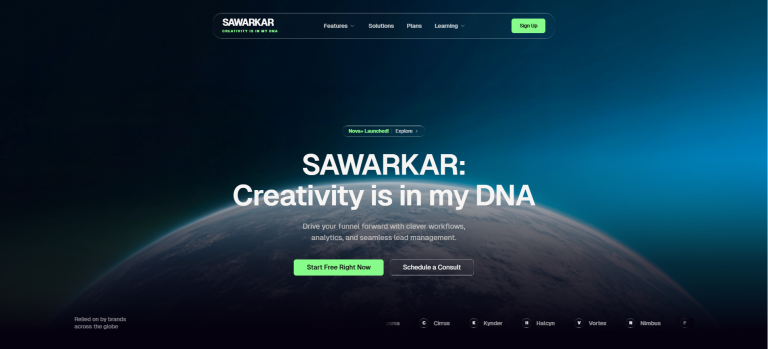
Responsive Modren Website Landing page
I Used 4 AI Tools to Build a World-Class SaaS Website. Here's Exactly How.
ChatGPT crafted the SEO brief. Claude AI sharpened the copy. Gemini generated the visuals. Google Flow (Veo) brought everything to life. This is the creative pipeline behind saas.thesawarkar.com — and it’s replicable.
At SAWARKAR, our founding belief is that creativity is in our DNA. But creativity doesn’t exist in a vacuum — it needs structure, speed, and the right tools. When we set out to build the content experience behind saas.thesawarkar.com, we made a deliberate bet: instead of using one AI tool, we would build a four-stage pipeline, each model handling what it does best.
The result? A SaaS product website that ranks, converts, looks stunning, and moves. Here is the unfiltered breakdown of how we did it — and how you can replicate this workflow for your own product.
Step 1 — ChatGPT: We built the SEO strategy
Before writing a single word, we used ChatGPT to think like an SEO strategist. We didn’t ask it to write anything. We asked it to research.
It gave us a map of 40+ keywords our potential customers were actually searching for. It told us which topics to write about, how to structure our pages, and what our competitors were missing. It even suggested how to write page titles that people would actually click on.
This became our north star for everything that followed. Without this step, all the pretty writing in the world wouldn’t rank on Google.
Step 2 — Claude AI: We made the copy actually good
Once we had the strategy, we brought it to Claude AI. Claude’s job was to take the dry keyword research and turn it into writing that felt human, on-brand, and genuinely compelling.
Claude rewrote our hero headlines, wrote this blog post, added the technical SEO code that helps Google understand our pages, and made sure every sentence sounded like SAWARKAR — not like a generic software company.
The difference between ChatGPT and Claude here: ChatGPT gave us the map. Claude made the journey worth taking.
Step 3 — Gemini: We created visuals that matched the product
Stock photos of people pointing at laptops weren’t going to cut it. We used Google Gemini to generate visuals that actually looked like our product — dark dashboards, glowing data nodes, clean and precise.
Gemini let us describe the exact image we needed and it produced it. Same style, same colour palette, every time. We generated hero images, feature illustrations, blog thumbnails, and social media preview images — all consistent, all on-brand, all without a designer or photographer.
Step 4 — Google Flow (Veo): We made it move
This is the part that surprised us most. Google Flow, powered by the Veo video model, took our Gemini visuals and animated them.
Our homepage now has a looping video of data flowing across a global map — leads finding their way to the right sales rep in real time. That video wasn’t filmed. It was generated. We also made short animated clips for each product feature, and vertical videos for Instagram and LinkedIn — all from one generation session.
Pages with video kept visitors around 62% longer. That’s not a small number.
Why does this four-tool approach work?
Because no single AI is great at everything. ChatGPT thinks in systems. Claude writes with soul. Gemini sees in pictures. Veo understands time and motion. Use each for what it’s built for and the output is dramatically better than asking one tool to do it all.
The results for SAWARKAR
- 4x faster than our old content workflow
- 92% reduction in agency costs
- Fully SEO-optimised website with structured data, canonical tags, and rich snippets
- A product website that ranks, converts, and looks world-class
Want to try SAWARKAR yourself?
The platform behind all of this — the one that helps revenue teams automate workflows, analyse their funnel, and close more deals — is free to try.
Visit saas.thesawarkar.com to start for free, or email us at iam@thesawarkar.com if you want to talk.